

I’m pleased to present a discussion with Sean Audain, the former City Innovation Lead and now Strategic Planning Manager at Wellington City Council. We covered a wide array of topics, from how Wellington is using sensors at scale to improve earthquake resilience, to the implications of improving legibility and narrowing information asymmetries thanks to AI combined with data collection at unprecedented scale.
The episode is also available on Spotify, Apple Podcasts, Pocket Casts, via RSS feed, and on fine podcast platforms everywhere. Just search for the ‘Public Service Podcast’. A transcript [with inline notes] is available below.
This recording is from the 2025 Sustainable Development Goals Summit at Massey University and is published here with the permission of the organising committee.
Timestamps
00:00 Introduction
06:20 Environmental Understanding
11:48 Enabling Citizen Engagement
21:06 Building Systemic Knowledge
26:55 Improving Civil Defence
31:25 The Golden Mile
34:41 Innovation Across New Zealand
Transcript
Adam:
So I’ve perhaps undersold m’colleague here a little bit. Yes, he’s strategic planning manager. He was on the Digital Twin Advisory Committee of the World Economic Forum as well. So there’s some credentials there, but perhaps most impressively from my perspective is just a long, deep, history of actually implementing this stuff. Being at the cutting edge really, (certainly within New Zealand) of things like digital twins, smart sensing, citizen engagement, and so on. Many of the technologies that you’ll see increasingly over last few years in New Zealand have had their genesis, at least nationally, initially in Wellington.
So before we get into the meat of it, one of the things should perhaps highlight to begin with is that unlike of the other conversations that you’ll be hearing where we’re talking about really transformative type, at least within a narrow field, perhaps whether it’s waste or governance or whatever, I would suggest that ‘smart cities’ is often more of an enabler of sustainability and of that transformative type change that you might be hearing about elsewhere in this [summit]. And so we’re talking really about what are individually relatively niche applications of technology, but that really open up a wide array of opportunities to provide information, for example, to the public so they can better understand what’s going on, enable councils or governance to more effectively respond to sustainability issues when they arise, and to reduce costs. Then I think, over time, and I’d be interested in your view on this, Sean, but over time we can build up a system of data and of understanding and of engagement with that information that can ultimately, when it’s integrated with these other things, lead to a completely different outcomes compared to the counterfactual.
Would that be kind of fair to say? Anything you wanted to add on that front?
Sean:
No, I just say that both of us are public servants. work with two different cities. I’m a city planner by trade, reaching into the digital realm. Adam’s a very deep expert on digital things, reaching into the city realms. One of the most interesting things about cities is they are the largest and most complicated structures that humans create and some of the least understood.
So when we talk about digital technologies being applied into those systems, they’re joining very complicated anthropological and ecological systems that we have created for our own well-being and livability. One of the great challenges of that is, as understandings of what cities are developed, we’re developing understandings that they aren’t just home to us, they’re home to other creatures as well that have just as much importance. So you’re seeing that shift from human-centered design to life-centered design. It’s happening in almost every human community at different paces and different ways, depending on their situations. In that respect, I think it just pays to remember where the word technology comes from. It’s a Greek word, ‘techne’ means craft, and that’s all this is. It’s about how do people craft things to understand these systems.
Adam:
That’s lovely Sean. I think just picking up on what you just said there. There’s some degree here where this is not a new thing. Yes, we’re talking about increasingly digital the use of digital technology, but really this is a process going back to the very first cities in general, you suddenly have some of perhaps, you know the most complex systems perhaps in the universe, certainly on our planet—if you think of it as a meta-system of all of these different people going about their days and transport networks and all the rest of it—and our challenge with them is often even to understand what it is that’s going on. Because if we don’t, you know, we’re talking about perhaps in the case of Palmerston North now, 100,000 people or thereabouts, depending on whether it’s the workday or not, in the case of Wellington, perhaps half a million connected to broader systems as well of other towns and so on.
If you’re sitting in Town Hall and attempting to make a decision about or to allocate some resource to improve water quality. Let’s say that council was allocated a budget to improve water quality and that’s on the back of some wonderful work done by the public to advocate for that budget and that program to be implemented. The challenge is then, where are the key areas that we can allocate that resource to have the greatest impact such that we can then build on hopefully some success and get people involved, tell that story and so on. But if you’re in town hall and all you’ve got is your own eyes and perhaps the odd submission from a member of the public through the LTP process or something like that, then how can you possibly know?
I think we’ve created bureaucracies, in a way, to try and solve this problem where there’s information flows that might be via word of mouth or via a form. Somebody goes out and checks a particular stream once a year, writes down some information about that, and then that’s processed, and then reaches a decision maker.
So just to wrap this point up, the idea here being that I think one of the exciting opportunities is that we can really improve compared to, let’s say, a millennia ago, where it’s what you could see with your own eyes and maybe a limited information network about what reaches your ears to [instead] a much more comprehensive understanding of what’s going on in these different systems, whether they’re ecological, transportation, human centric, and so on.
Environmental Understanding
Sean:
Yeah, so picking up on your example of water quality there. One of the things that defines city planning from any of the other built environment professions like civil engineers, architecture, landscape architecture, is we are defined by our relationship with power. So city planners are the people who understand and work within the system of a democracy interacting with the built environment. So to pick up on that example of water quality, we have a particular problem in the north of Wellington. So Tawa has a large drainage basin that drains to the Porirua Harbour, which is in Porirua City, next city over. That harbour has suffered from historic siltation, and it’s not in a great state, but it is the taonga of Ngāti Toa Rangatira. And so one of the first digital experiments that was done was to work with Ngāti Toa to set up a digital twin to help us understand what’s in the harbour. A digital twin is a digital fusion between the environment and its measurement systems. So what it means is you can put on a VR headset and can see all of the instrumentation. You can synthesise that environment digitally so it mimics what’s happening physically. And then you can start to move things backwards and forwards in time.
Wellington’s unusual in New Zealand and that it maintains this digital copy of itself. So we extended that to the North [into Porirua]. But in doing that, what we were doing is also starting to understand what does this mean for New Zealand? What does indigenous data sovereignty mean in the digital realm? How is tino rangatiratanga expressed? And it goes beyond simply make sure the data is kept in a compatible jurisdiction. It goes to concepts of whenua and the relationship to whenua. So what then happened is we, as a city said, actually, we will do a step back. Ngāti Toa will run this and we will become the junior partner. And that’s now led to the Porirua Harbour Accord, which has all of the local governments that have correct drainage basins into that harbour. That system of government I was talking about as a city planner has fused with that system of understanding and insight to create this multi-party system where each of us can understand how our system affects the others. So what you end up with is the inflows of information to make a better democracy, but to also start exploring that relationship between tino rangatiratanga and democracy. And that’s a really difficult space because that tension between tino rangatiratanga and democracy is the unwritten context behind almost all of the arguments about the Treaty of Waitangi and our history over last 200 years.
Adam:
So just keen to, for the sake of the audience, sort of scaffold us towards your ultimate points there. I think that. In this example, moving from an individual seeing a water environment being degraded, let’s say maybe they have a long history with that place, maybe a multi-generational history with that waterway, can see that Kai Moana [seafood] stocks have been declining relative to the stories that, perhaps, they were told. And then to go from that, which is very highly contextualized—important, but difficult to action—And then to go from that, as we have, let’s say in the 20th Century to a formalized system of water quality indexes and so on, which maybe a scientist has gone out and periodically collected some information about that. That goes in an annual report, let’s say, and is even more contextualized in some way and difficult to engage with as a member of the public. It’s some table buried on page 80.
I think one of the things that Wellington’s done extraordinarily well is to be able to present that information and improve the frequency and the information density of what’s happening in different parts of the harbour that we can see and track over time. You could, in the simplest case, present this as part of a dashboard, let’s say, of a particular place where we can look at a water quality index and it maybe over many, many years it has declined.
As you increase that level of information density, you might be able to see that there’s some seasonal fluctuation. Gosh, what’s happening there in the winter? Is there some particular activity happening in winter that maybe could be addressed, that could help address the [broader] problem?
And then I think what Wellington’s done, as I said, this digital twin is to take that from a very bureaucratic and technocratic deep understanding that’s going to require a lot of work to get your head around and reading these different things. Maybe it’s a two dimensional map that not everybody can engage with to a three dimensional model with some simple tools that can give people once again the sort of the richness of an understanding of what’s happening in that harbour at particular time. They can see it spatially. They can use VR goggles if they want to, to sort of see that that particular area is redder, let’s say, than this particular area over here and then use that to guide, you know, action, whether that’s political or technical to address an issue.
Enabling Citizen Engagement
Sean:
Absolutely. A similar thing has been done for the east of our city, Miramar. So it’s a very low-lying area and subject to lot of natural hazards. And so what we’ve done is we’ve worked with mana whenua and local historians to map the last 400 years. Miramar wasn’t always a peninsula, it used to be an island before 1450. Then the whole basin was raised by an earthquake. What we can do is show how that change that has been occurring bit by bit every day the last 400 years looks with the projections of climate change. So we can take the abstract ideas of ‘this is what the exceedance curve for flooding looks like’ [then] project that into a landscape where people can see their own house. They can see how the land was before their house was there. They can see how the land might be in 100 years time, and they can start to understand what the both the threats and the opportunities are from climate change and how some of these different hazards interact. Because it’s not when the sea level rises, it doesn’t just cause things to get wet. It saturates soils, which can increase the liquefaction potential for earthquakes. They can affect water supplies. There’s all sorts of consequences.
But what it does is it also allows people to then move through the city. They can take their daily commute and they can understand, okay, what does climate change mean for my life? And then actually, I’m probably not going to be commuting to work in quite the same way in a 50 years time. What does it mean for my children’s lives? It’s through that diffusion of information into people’s lives that you begin to be able to sustain that democratic decision making.
That’s ultimately one of the big drivers behind these decisions for people like me to invest in these things. Because climate change is not going to be solved by a vote. Climate change is going to be solved by generations of people making little decisions every day for the next century and a half. And that means that for our societies to do that, we need to be able to sustain a healthy democracy over that time. And that then becomes the reason for the investment in these digital systems. Because how do public servants who have been running off essentially a 1950s mechanism of go out into the world, find out the piece of information, whisper it in the ear of the mayor and have them proclaim it to the city. That doesn’t work anymore. Transparency, the growth of enmeshed digital systems means that with capabilities like ChatGPT, a member of the public, if they have the technological knowledge, can have capability that outstrips entire departments now. So in a system of government that is founded upon the idea of the symmetry, how do we function? That ultimately is a very selfish driver for some of this stuff.
Adam:
So I was going to go somewhere else, but the point you’ve raised just at the end there, ‘founded on the idea of information asymmetry’. Could you expand on that a little bit? Trying to keep secrets from the public?
Sean:
There’s not so much that you’re trying to keep secrets from the public. I don’t want to cast aspersions on previous generations’ public servants. But if you think about it, the business of government is very complicated. The May Budget is a really good example. So the budget is passed by the government in May and it tells you all of the spending priorities for the following year and it’s normally about 12,000 pages. I can guarantee you that none of you have ever read it. If you have read it, doubt you’ve understood every single thing in there. I can say that because I have read it and I didn’t understand everything in there. But with some of these analytic tools, you can begin to unpick that and understand, OK, this is where the money is moving to. This is what the rhetoric says versus what the departments are being programmed to do.
When you have that level of knowledge, then your ability to argue and advocate within the democratic system increases. If you’ve founded power structures based on information flows being too complicated for other people to adequately engage with, you’ve never had to deal with that many people. So that becomes one of the challenges modern local government is we have a lot of consultation mechanisms built into our decision-making through the law. I think that’s a very good thing. But with the ability of automated decision making and analytical tools, those decision making mechanisms are becoming overwhelmed with content. And you’d start to get into the position of you’ll use a large language model to draft the submission and I’ll use the large language model to analyze the submission. And at that point, what do we actually achieve?
Adam:
Can I almost play devil’s advocate here a little bit? Part of this information asymmetry, you could argue, from deconstructivist point of view, would be sort of the maintenance of power through obscurity and various forms of injustice associated with that. A flip side, but perhaps on same spectrum, is many decisions are made in a highly contextualized environment that if you strip that context away suddenly can appear to be perhaps much worse than they are. One example that pops to mind is the use of 1080, possibly a little controversial in this room, I’m not sure. But just for the sake of argument without getting, let’s imagine this is a thing where it’s poison, it’s highly toxic in certain circumstances and it takes a lot of understanding to kind of go OK, yes, but it’s water soluble. It’s not harmful in these particular ways, and breaks down and blah, blah, blah, and thus is a highly useful tool when we’re talking about conservation, but we don’t necessarily want to have a big debate about it every single time about its use.
Collectively, as a society, we’ve decided that as long as it’s not too out of hand—you could say there’s something of an equilibrium here that has formed—as long as the use doesn’t get too out of hand, we kind of broadly accept it, but that we’re not particularly interested in. by analogy here, I’m almost thinking of like the NIMBY-YIMBY dichotomy, where there’s a challenge for any particular application, even if on a system level, we’re happy enough with it.
[i.e. extreme public transparency on housing consent applications would strengthen the case against any individual new build (which after all will cause construction noise and a variety of measurable negative effects), even while, as a society, we might agree that we need to build more housing in general].
To bring it back around, sorry I’ve lost the audience here a little bit, I apologize. But I think again of I’m not sure that all forms of transparency are useful, particularly if you’re only extracting sort of the high level summary of a particular thing. Some degree of sausage making occurs within governance that’s not necessarily entirely acceptable to everybody. And as long as we can kind of abstract it away, it lets things continue to function.
Sean:
This goes back to the nature of democracy. We don’t all agree. That’s why we’ve got it. So it’s quite natural that people will disagree. A good example of an argument that turns up about every 10 years in my experience is the one about dihydrogen oxide, and somebody gets terribly het up about it. Dihydrogen oxide is a chemical named water. It sounds like a poison, but it’s really quite harmless unless you have too much of it.
The argument about transparency does become quite interesting because there are negative sides of transparency and you can see that through the harassment, particularly of women politicians. It’s becoming increasingly difficult in the digital realm. But that goes to one of the basic problems that sits at the heart of this sort of technological view of the world. And that technology is neither good nor bad. It’s just craft. But it has a massive amplifying effect. It’s that amplification that can be both so good, that can help us understand cities so that we can make more informed policy decisions. We can better engage with people. It can be used to put people on a level playing field. So for example, we have citizens who use voice-to-text capabilities to deal with difficulties in writing or typing, physical impediments. But it can also have significant negatives where people have done flawed analysis that has proven to be very difficult to actually unstitch to find where the problem in the spreadsheet was. It’s been used to, like I said, harass politicians. There’s all sorts of downsides to it as well.
Adam:
Sure. I’m going to beg your indulgence one more time and then we’ll move on. A better example perhaps [than those I presented earlier] would be… I think the use of television cameras in parliament, arguably has been negative. Because the second you make that highly transparent, the entire thing highly transparent and public, you take away the ability for politicians to compromise without publicly being seen to have given up or away some particular position. So the entire thing devolves into a sort of grandstanding and then subsequently real decision making moves away from the house and into [backrooms]. But anyway… just food for thought [laughter from audience].
Building Systemic Knowledge
So one schema I have here, just coming back to this idea of the utilization of digital monitoring to improve decision making—we’ve talked a lot about the governance level in terms of providing better information for, let’s say, politicians or the public to understand what’s happening and thus begin to take some action or build a coalition around addressing a particular problem like in Porirua.
Then if you go down into shorter and shorter timeframes, I think you see different kinds of opportunities. So thinking about, let’s say, active transport. The mode for much of the last century when we’re talking about, let’s say, cyclists or understanding the movement of pedestrians has been ‘you send a person out there, maybe an intern or a graduate with a clipboard. They go out once a week, 10am to 12pm, and just count manually what’s happening’. Systematically, as a result of that—it’s quite expensive, it requires a human being—and you systematically exclude from that data set potentially, let’s say, school children because they’re in school during that period and so you know possibly you end up missing a particular piece of that data set and you go we’re not serving this particular demographic at all not through any fault of our own but just because we had poor data and so by filling that in with digital monitoring you begin to have a much more complete picture of what’s actually occurring whether there’s maybe, you know, women are less likely to use this particular route and so on. And then thus you can much more easily targeted interventions and improve services.
Sean:
Yes, at the moment we’ve nearly completed the rollout of a thing called the VivaCity, which is a visual learning cordon around the city, around Wellington City, which basically allows us to count pedestrians, trucks, buses, anything that moves basically. And that is part of the reason, is because when that comes down to the planning systems I run, if there’s no data, it becomes difficult to balance decisions.
It’s one of the reasons why we tend to worry an awful lot about access to driveways, not so much access to pedestrians, because there’s lots of information about what the car volumes are and traffic volumes from historic counting systems and data sets, much less about pedestrians. So when somebody turns up with numbers into a system that’s founded upon some sort of analytical calculation, and the other person doesn’t have numbers, it’s naturally not particularly fair process. And so one of those big things has been to fill that in.
The other thing it helps us understand is where there are logics built within the city that can help us with future problems. So most of Wellington’s growth is through intensification. We’re founded where a mountain range plunges into the sea, so we don’t have a lot of land. So for almost all of my time at the city, it’s grown through intensification. We’re really quite lucky because we still have schools in our central city. If you look at historic maps of Auckland, one of the things you’ll notice is around about the turn of the 20th century, the first sort of the decades outside, the schools left Central Auckland. There are no primary schools within the motorway ring now. And it’s because that segregation and passing out of the city occurred where the children were being, the families were being pushed out by motorway extensions and then by specialization of land use. It makes it extremely difficult to retrofit communities into that area that have any children in them, because of that. A similar thing can be seen in the layout of bus systems. And one of the things that we found after COVID was those cities that had accounted for non-commuter patterns had far faster recovery in passenger volumes than those that were very specialized. So basically, if your bus worked for people doing the shopping and people going to school, your transport system recovered much faster after COVID. It kind of makes sense when you think about it.
Adam:
Right. So and then just to maybe maybe complete the two dimensional drawing of this scale of this opportunity. I see also there’s—in terms of smart cities—a third layer, is really in the immediate sense of you have information flows, let’s say from a set of traffic lights is a classic example. The richer the information that can be going into those control systems the faster that you can move people through that set of lights, right? So at the moment, you have a button, you push it, and there’s no differentiation, let’s say, between one person that’s just arrived versus there’s a large event and there’s 40 people all clustering around and they all have to wait while one car over there kind of trickles through and then there’s a delay until the light phasing because it’s set up so that there’s 30 seconds between each phase. So you’ve got 40 people waiting for, let’s say, two and a half minutes or two minutes when you could quite easily have prioritised them. But as long as you just have this very binary, ‘is there a pedestrian or not’ from the button, you can’t begin to make that sort of system work in a more equitable fashion.
So I’m quite excited about some of the opportunities in that space and like I said, traffic lights is an obvious example for me. If you can have a richer understanding of what’s going on using computer vision, then you can make much smarter control systems. But I wonder, is there other areas that Wellington’s looking at in that space of just immediate feedback?
Improving Civil Defence
Sean:
Yeah. Earthquakes are probably the one that’s most developed for us. So we have a thing called the Sentinel which is in all traffic light cabinet, so it’s spread out in a grid across the city, and they’re accelerometers, so they measure ground shaking. What it means is that information surges back to our control centers immediately after a shake, and it tells us whether different parts of the city have shaken at different forces because it depends on what you’re sitting on as to how it jiggles basically. And what is has done is changed our workflow. So previously what we would do is we would basically play battleships—we would divide the city into grids and then send the inspectors out and just start ticking off grid by grid. What this does is it means we can prioritize. We can send the inspectors to the areas that have shaken the most, or the ones that have got the most vulnerable buildings, which speeds up response times. It also allows us to make smaller cordons, which disrupt people’s lives less. Because it means you can cordon around particular buildings rather than cordoning off entire neighborhoods. But there’s quite a number of examples. Landslips is another one. So certain hillsides above major roads have sensor systems on them that allow for very quick decisions to be made about protecting those roads if the land does begin to move.
Adam:
I mean, the whole civil defense space in general just seems like ripe for this sort of thing. If you can understand immediately which roads have flooded or which culverts have topped over and you can direct action in a way that is virtually impossible in a, let’s say compared to 40 years ago where you’re waiting for radio reports, somebody live on the ground to…
Sean:
That then goes to the other challenge with this because as you optimize systems, A, you have to be very careful what you’re optimizing for and B, the more optimized a system becomes, generally the more fragile it becomes to disruption.
Adam:
Sure, and indeed, if you’ve got a really comprehensive picture of 60 % of the territory, let’s say, or the city, or systems within a city, the tendency is going to be to put resources into that 60 % rather than the 40 % which have struggled to yield to digital monitoring, let’s say. So there’s some real kind of philosophical governance questions to be discussed.
Sean:
Yes, you end up with the sort of squeaky wheel gets the grease, and you can see that in reporting systems across multiple cities, where generally wealthier neighborhoods have their infrastructure maintained better. And it’s largely because they complain and put in the request for it to be fixed.
Adam:
Right. That’s another example where I can see an opportunity here for digital monitoring where it’s done in more comprehensive fashion, let’s say, with cameras attached to the rubbish trucks that go across the entire city. You can thus build up a picture of exactly where maintenance is required independently of needing somebody to complain about it and thus prioritize accordingly.
Sean:
Yes, and that’s where it comes back to the democratic motivations too, because you have to be able to pair a lot of this with open data and transparency, because ultimately me having all the information doesn’t necessarily solve that problem of how do we have a better and more sustained democracy and how do we get towards the sustainable development goals. What’s needed is for citizens and organisations within the city to have information so they can make the best decisions too, because adaptation is a team sport.
Adam:
Sure, and I mean I know a lot of work’s been done overseas in the space, but again, Wellington’s been leading not only with the digital twin and the sort of user interface of open data, but making more of this stuff more easily accessible to the public, right?
Sean:
Absolutely. We have recently passed the district plan, so the regulations allow for the building of the city and the density arguments they’re currently having in Auckland— we’ve done what they’re about to do—and as part of that, we took an almost aggressive approach to transparency and published everything. What was remarkable is I believe I’ve answered three information requests on the entire thing, because all of the information was in the public realm, and I can tell you that nothing makes me happier than to deny a mission request because I’ve already published it.
The Golden Mile
Adam:
Yeah, uh, is there a question? Yeah. Yeah, go ahead.
Adam:
Just for the sake of those online, I’ll just see if I can question here is that the proposition is that digital technology has enabled opposition around the Golden Mile to form it perhaps more effectively than it otherwise would. And what’s the role of smart cities to sort of maybe counterbalance that?
[The ‘Golden Mile’ project has been a long running saga surrounding the upgrade of a series of arterial avenues through central Wellington. Concerns about parking removals, and cost overruns have predominated, and the project was paused by Councillors shortly after this recording]
Sean:
So… the Golden Mile conversation of my world culminated with a two hour briefing to the counselors on how data works. What we did is we got the sensors out and showed them how it counts. We showed the counselors essentially what are the blind spots in each form of sensor technology, because there is nothing that counts everything perfectly all the time, and there is always something in the data that means that it’s not useful for some particular purpose. And one of the really interesting parts of that debate has been the… discussion about ‘what is data?’. You normally know when you get into the heart of a matter as a planner when the question becomes, you know, what is window? What is building? But we ended up with what is data because essentially, anytime the data said something on either side, that they didn’t want to hear, ‘that’s not data’. It’s like, yes, it is.. you need to… So what ended up happening is you ended up with this interesting reversal of essentially, no, you need to show how your analysis is correct. You need to show how the data is either not right for this purpose, but we’ve disclosed how it works. We’ve shown, councillors…
The other thing that’s become really interesting is democracy does not run off data. We never wanted to be a data-driven city. I still don’t want to be a data-driven city, but what we want to be is an informed democracy. That’s a little bit different because it’s perfectly okay to make decisions not based upon data. You just have to know you’re doing it. Some decisions are not amenable to data. So for example, yesterday the city passed its Rainbow Action Plan. It might be the first in the country for one. That’s not a plan that should be driven by data. That’s a plan that should be driven by what is right and what is wrong and essentially an idea of how a city should be [i.e. values]. And so during the Golden Mile, that’s where that divergence has taken place, actually the judicial reviews and the... I’ve been through six judicial reviews this term. Normally I get one every three or four terms. Those arguments have moved away from the data, which I find quite interesting.
Adam:
I think one of the things to just respond to your question, briefly is that we, particularly in transport spaces, I would say as a, let’s say a nation, we’ve lost track of some of the fundamental understandings of how you actually need to deliver pieces of infrastructure that substantially changes levels of service for different users.
[Unfortunately the audio recording cut here, and we lost roughly 15mins of discussion, largely about change management and project delivery.]
Innovation Across New Zealand
Sean:
[Wellington was the first] city to introduce innovation function as a standalone function within its local government. I was in that team for a while. Christchurch and Auckland also set up and Tauranga set up similar functions at the same time, which is after it. I think in Wellington, the difference was ours was viewed as a strategic function, but it wasn’t viewed as an individual capability. We were deliberately set up as a relatively weak team to force us to work with the organization, and what that meant was we worked with the specialists and the people whose core business was to do the things that are needed to adapt their behavior and change the way the city government worked.
Basically the difficulty with changing culture is culture is what you do when you’re not thinking so it’s very hard to actually change it. You’ve to become conscious of what you’re doing, and so because of that strategic focus that we didn’t have an innovation plan or a smart city plan. We just had the city plan so that’s what we did.
In Christchurch they’ve got a really successful model as well but theirs is quite different. What they do is they experiment lots and basically throw things at the wall. So they’ve achieved lots of really interesting things, in a probably less systematic way than we have. Both have their strengths. They could move faster than we can, but we tend to move everybody when we do move things. Auckland, their innovation office kind of got lost in their council family and sort of ended up dropping out the bottom.
Then Tauranga, they’re probably the most interesting one because they were set up as quite standalone. Then they began to critique their organization and the immune system of that organization basically got rid of them.
Adam:
I think there’s something to be said for scale, at least when you’re starting out. That Wellington is, I think, probably in quite a nice position for this kind of work in that it has the resources and it has IT teams with specialized knowledge and so on that the likes of Tararua District Council just is going to need to wait until that’s all kind of standardized and they can just download the package that maybe the likes of Wellington or and then it filters down to us and we implement and then they can just go ‘OK, this is what we do’. So I think innovation is really at a city level is often quite [dependent on scale]. We’re probably the lower end here in Palmerston North of where [~smart cities] is viable and I’m proud of achievements that we’ve made. And then you struggle, think, Auckland Council is just extraordinarily bureaucratic and siloed, at least in my experience. I think most of the sheer scale of both geographically and from a personnel point of view, most of the individual business units within that are never engaged with the bottom or the top of either SLT or actual on the ground people. They’re just talking to other business units that are one up and below them, which I think has its purpose but makes it a struggle sometimes.
[On the other hand, the Auckland Supercity has been extraordinarily successful in other areas, particularly housing development and urban design, as I discussed recently with Ludo Campbell-Reid. Different sorts of ideas and innovations are easier to develop at some scales compared to others].
Auckland's Design Champion, Ludo Campbell-Reid
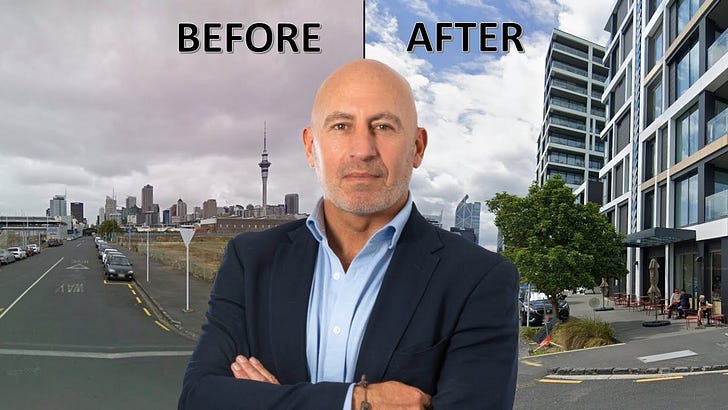
Ludo is one of the most interesting and successful public servants of the 21st Century, leading a radical transformation of Auckland’s urban design over his 13 years as the city’s ‘Design Champion’. YIMBY’s rightly celebrate the city’s upzoning successes and improving affordability
Sean:
If you want a small place that does amazing things, Taupō is like the sleeper hit. And then if you want a middle-sized place that does surprisingly cool stuff, Lower Hutt. They’re the ones that I’m currently envious of.
[At this point I was being asked by the volunteers to urgently wrap things up so they could prepare for the next session].
Adam:
There you go. Yeah, well, thanks everyone for coming and yeah, thanks to Sean for driving up here and I hope you’ve enjoyed it.

