
A Nation Must Have Datacentres
Fundamental infrastructure for the 21st Century.

On June 12th 2026, the US Government issued a directive limiting distribution of Anthropic’s ‘Claude Fable’ exclusively to American citizens on the grounds of national security.
The event is a major escalation in the geopolitical struggle over AI. That the event was completely unreported by New Zealand’s media is the clearest sign yet that our intellectual class is completely unprepared for the new reality now taking shape. New Zealand, like other small nations, may lack the resources to train frontier models of its own, but has a golden opportunity to secure its future capacity needs, if it can act decisively.
Superhuman Capabilities
Fable is the most advanced AI ever released to the public. An early version of the model, ‘Mythos’, was selectively released to trusted partners under ‘Project Glasswing’ after the model found massive security vulnerabilities across every operating system, web browser, and piece of digital infrastructure. Even with Cloudflare, whose services protect ~25% of websites, Mythos found and helped patch over 2000 vulnerabilities across its critical-path software.
The New Zealand Government received access to Mythos through Glasswing, but despite New Zealand’s ‘Five Eyes’ membership, its citizens are excluded from the list of approved Fable users.
Capabilities are advancing rapidly, and today’s AI models are the worst they will ever be. Any nation, if it is to retain a semblance of sovereignty, must secure access to cutting-edge AI. Long derided as an unreliable toy, AI can now find novel mathematical solutions to Erdős problems, revolutionise medical scans, and build compelling and original video games. AI are undoubtably ‘spiky’, and still fail at many tasks humans consider simple, but their power and importance for the future is now undeniable. The cybersecurity implications alone will provide incredible leverage to hold any nation without such capabilities hostage.
The Tightening Web
Leaving aside the murky circumstances and dubious legality of Fable’s export restrictions, the direction of travel is clear across multiple administrations. In 2022 Biden implemented export controls on both the advanced chips needed for AI and key semiconductor manufacturing equipment required for their independent manufacture1. Sold as a necessary measure to limit China and maintain American supremacy, the controls created an outright ban on exports to the likes of China, Russia, Iran, but ultimately also placed stringent limits on exports to ‘tier 2’ countries, including many EU member states like Poland and Portugal, let alone wider US-aligned countries like the Philippines and Saudi Arabia.
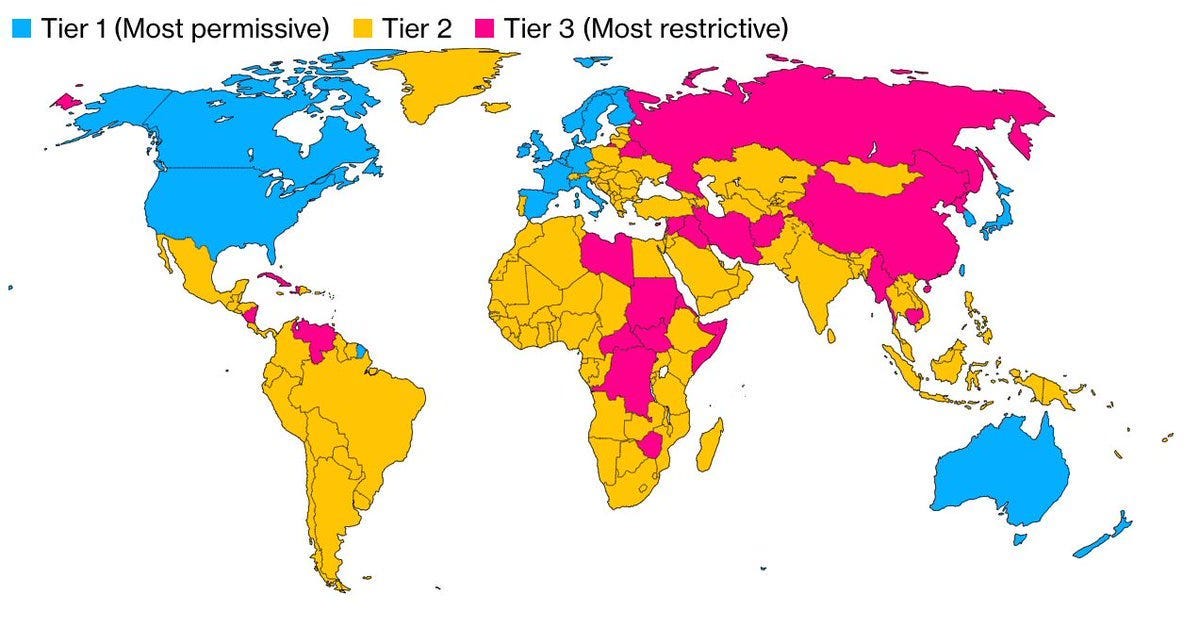
When NATO allies are put on an export restriction list by a Democrat administration and G7 allies are explicitly denied access to the latest models, to say nothing of the recent widespread imposition of tariffs on key partners on the basis of a mild trade surpluses, we must accept that the days where Western co-prosperity could be unquestionably assumed are sadly behind us.
Any nation not critical to the AI supply chain (e.g. Korea, Taiwan, the Netherlands2) should prepare for America’s dominant position in AI to be used as leverage against them. The more that a nation moves now to both secure capacity and enable open-source alternatives3, the better positioned they will be for that eventuality.
Capacity Constraints
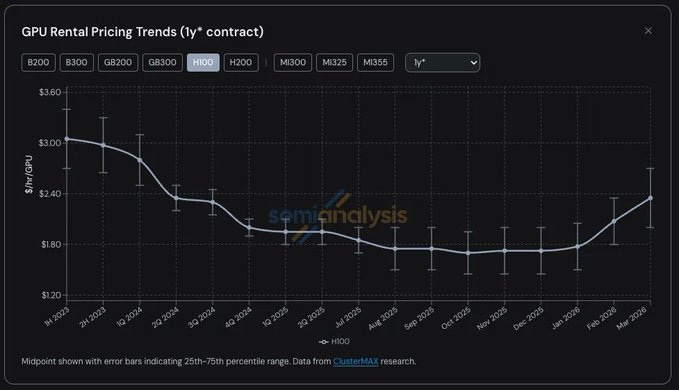
Even without formal restrictions on AI models, nations may still find themselves locked out of access by compute shortages and simple economics. Contrary to mainstream concerns about an ‘AI bubble’, AI chip rental costs have increased markedly in 2026, even for old chips, as demand has skyrocketed since entering the agentic era.
As AI continues to improve, usage will proliferate. As it proliferates, access to compute will become as critical as electricity and oil. Being cut off means your country loses its cybersecurity capabilities, local companies that are integrating AI throughout their business grind to a halt, research programmes are delayed, costs blow out, and, as we’ve seen with the Hormuz blockade, the pressure is on for a short-term political solution that won’t be in the best interests of foreign consumers or long-term investment.
Sovereignty
Much has been made within governments of the subject of data sovereignty and instituting proper controls and ownership mechanisms, but the reality is that relying on overseas datacentres to process critical workloads is to risk the data being stolen by overseas actors or surveilled by security agencies and courts through mechanisms such as Australia’s TOLA or USA’s FISA, to say nothing of losing access entirely should vulnerable undersea cables be cut.
In fact, datacentre NIMBYism is a shortcut to losing sovereignty in the broadest sense. Europe 2031 recently outlined a credible scenario of how Europe, despite having every opportunity to build its own models and secure on-shore datacentre capacity, loses its sovereignty by caving to populist incentives and naysayers instead of building the basic infrastructure of the 21st century. If the threat to such a large and important bloc as the EU is even plausible, small and/or isolated nations should consider it the default outcome.
Fundamentally, if a nation’s government, banks, universities, energy companies, and cyber security companies cannot reliably run critical AI workloads inside their nation’s borders and under their laws, insulated from any supply-shock, export-control dispute, cable outage or pricing squeeze, then their nation is vulnerable to malicious actors, state or otherwise. Such vulnerability can and will be used as leverage against that nation.
Unprecedented Investment
Nations looking to secure datacentre capacity need not even fund it themselves. The economics of datacentres are so compelling that American tech giants like Google, Amazon, Microsoft and Meta (i.e. the cloud hyperscalers) are scrambling to build as much as they possibly can. Current expectations are for hyperscalers to spend $1 trillion on cloud infrastructure in 2027. Google, now seeing absurdly high operating margins on cloud is scrambling to raise even more investment capital. After decades of buying back it’s own stock, it has just reversed course to raise $85b of additional capital to fund expansion, atop ~$200b of annual operating profits its funneling into datacentre capex.
The investment case is so overwhelming that hyperscalers are more than willing to tolerate much higher costs in order to bring capacity online sooner. The backlog for new grid connections in the US has grown to 6-7 years. This has forced a shift to on-site generation, creating a massive shortage of heavy-duty gas turbines and 3-5 year lead times. Now hyperscalers are turning to fuel cells to bring datacentres online years earlier to attempt to meet demand, despite the significantly higher energy costs associated with the technology.
A nation with excess grid capacity can make a compelling case for hyperscaler investment, but must be able to compete with the US on speed, clarity, and scale. Too many projects have languished for years in convoluted permitting processes, and hyperscalers are understandably shy about getting stuck in another morass and losing ground to their competitors.
Golden Opportunity
New Zealand is extraordinarily well positioned to capture hyperscaler investment. We’ve got a consenting regime coming online that can provide certainty to developers, our nation is building out generation capacity, new overseas data bandwidth is coming online, and a visa system that makes it easy to bring in the technical expertise needed to stand up these complex systems.
Why New Zealand is an Overlooked AI Hyperscaler Opportunity

While higher latency and electricity costs make New Zealand a middling candidate for startup-scale datacentres, recent legislative changes help create an exceptionally low-risk environment for AI training. Further, world-class geothermal resources give New Zealand substantial additional generation capacity, which can be scaled to meet demand.
What doesn’t stand in our favour is a history of past failures, and the only way to overcome that is political leadership from the top in designating AI compute as strategic infrastructure, and providing a clear pathway to completing developments in a similar timeframe to what’s being achieved in the US.
Given that New Zealand would not be paying for this critical infrastructure, and furthermore that the environmental case resolves to little more than a moral panic perpetuated by self-styled ‘experts’ and New York bestsellers that make fundamental errors overstating the water use by a factor of 10004, the economic case writes itself. What's needed is leadership to make it happen.
The most important of these restrictions was the ban on export of ASML’s EUV machines
Among other components, Korea produces a majority of the world’s cutting edge memory, Taiwan the overwhelming majority of cutting edge chips, while ASML, based in the Netherlands, has a complete monopoly on the EUV machines required to produce both.
Today’s leading open-source models include Deepseek’s v4 and recently released Zhipu GLM-5.2. These Chinese models lag roughly six months behind the frontier, but can be run at 1/10th the cost of GPT/Claude for a similar level of intelligence, being highly optimised for efficiency given the limited compute availability of Chinese labs. Being open-source/weights, these models can be run on secure local servers without any risk of data leaks through to their model’s creators, unlike competing offerings from even trusted partners like Microsoft.
To the author’s credit, she has since updated the book to correct the error. Unfortunately the idea that datacentres are massive users of water remains a popular conception. In fact, their true usage is on the scale of a fast-food joint, and improving all the time as water recycling technology improves.
Can you explain the economics behind the datagrid proposal in Southland? 3.5 billion to build for a return of 60 million per year in gdp. That seems like a very low return on investment